From England to New Zealand, culinary festivals are multiplying, flourishing, emerging and disappearing around the world. The most classic ones welcome local chefs to pay tribute to local specialities, the most luxurious ones count their stars, the most popular ones are organised in the street... or still others surprise the most curious. Adventurous? Go to Hokitika and try the New Zealand quirks. Daredevils can go tumbling down Cooper's Hill in pursuit of a cheese or throw tomatoes in Bunol, Spain.
Cooper's Hill Cheese Rolling Festival, cheese at any price in the UK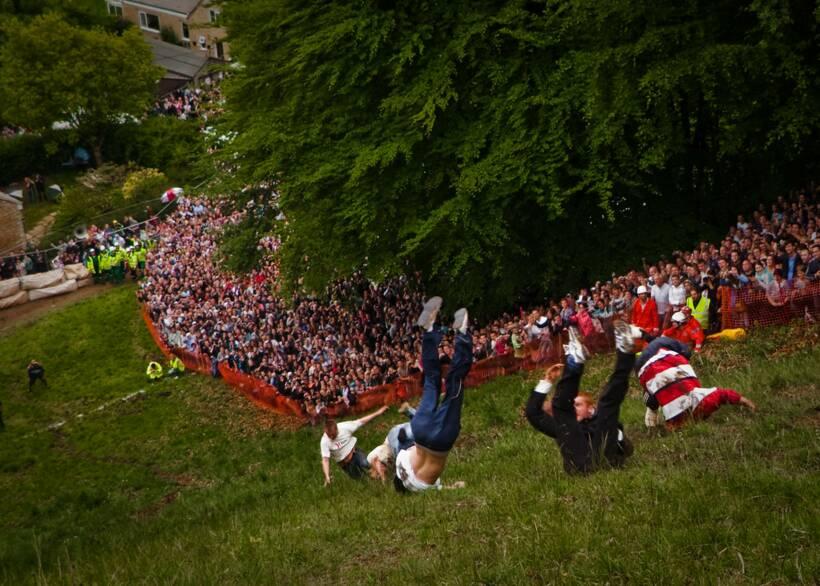
Every year, a hundred or so 18 year olds come to roll down the slope of Cooper's Hill, located in Brockworth in the UK. Many don't finish the 200 metre climb and never reach the finish line. At the bottom, first aid services are responsible for collecting the injured, who are brought in by volunteers when they can't finish the race on their own.
And why do participants risk their ankles, wrists or shoulders? A cheese. Not just any cheese. A 3.2kg Double Gloucester. Launched a second before the participants start, it can reach up to 100km/h. It is even said to have injured a spectator in 1997. In theory, the winner of the race is supposed to catch the cheese. However, given its speed, this rarely happens. So the prize is usually awarded to the person who reaches the finish line first.
⋙ National Cheese Day: our tour of France's cheeses in ten regions
The poor condition of the terrain and the steepness of the slope, which sometimes reaches 50% on some parts of the race, make it a very difficult race to finish. In 2005, the last race had to be delayed to give the ambulances time to return. They had all been mobilised by the injured from the previous race. Nevertheless, about 5000 spectators attend each year and the five races that start at noon always find participants. The tradition is estimated to be 200 years old.
In the land of grubs and crickets: the Hokitika Wildfoods Festival in New Zealand
Every second Saturday in March, the small town of Hokitika on the west coast of New Zealand comes alive with a very surprising event: the Wildfoods Festival. This culinary event, which has been going on since 1900, now attracts more than 15,000 food adventurers. As the name suggests, the festival pays tribute to the "wild food" of the New Zealand coast, which is known for its bizarre specialities. On the menu: ice cream with wasp larvae, oyster sandwiches, shark, scorpions to be eaten raw or cooked according to taste, maggots...
The great speciality of the region, not to be missed, is the huhu larvae, an insect endemic to the country. These large white worms are 7 cm long and are found in dead wood. They are usually grilled and served as a snack. It is then possible to attend the many performances organised during the festival (concerts, comedy, dance, mime...) with your wild aperitif.
Themed areas also allow participants to focus more precisely on one type of food. They are then invited to the worm café where they can taste chocolate truffles with maggots or earthworm sushi. A milk bar is also available. On the menu: cheesecakes, mousses, or simply shots of colostrum, the maternal milk produced at the time of the child's birth and therefore known to be high in antibodies and proteins.
There are many other amazing stalls on offer at the festival, but we won't spoil the surprise.
In Buñol, bathe in tomatoes
Tomato lovers, this festival is for you. Every last Wednesday of August, the small village of Buñol in Spain is transformed into a real battlefield: it's the Tomatina. This festival, which dates back to 1945, is a celebration of the village's patron saint, Saint Lluis Bertran. In 2002, the event was awarded the title of Festival of International Tourist Interest by the General Secretariat of Tourism of Buñol.
According to legend, the young people of the time used to gather in the town square where the event is now held. In order to attend the authorities' parade, they provoked a stampede which degenerated into a general brawl during which some used tomatoes from a small shop nearby as projectiles. A year later, a group of young people deliberately repeated the scene. This demonstration was initially banned by the authorities and it was finally in 1959 that the Buñol City Council authorised the fight, which became an official city event.
⋙ Tomato wine, an original drink from Quebec
From now on, the town council institutes a start and end time. It even provides the 150 to 170 tons of tomatoes to the participants, supposedly spoiled and not for sale. Stored for two days before the celebration, they must reach a sufficient level of ripeness so that they are not too firm to avoid injury. Certain rules are imposed on the organisers: it is compulsory to press the tomato before throwing it at the other participants. It is also advisable to wear old clothes and swimming goggles.
At the end of the battle, some people take the opportunity to enjoy a good tomato bath, with the juice that has been spilled on the streets.
A giant omelette just for you
In Bessières, the Confrérie Mondiale des Chevaliers de l'Omelette Géante meets every year on Easter Monday. It is a tradition for the young people of the town to meet on the banks of the Tarn to enjoy the customary omelette together. As the gathering became more and more important each year, Bernard Beilles, president of the Confrérie, decided to create this amicale whose aim is "to prepare and to make the Bessière inhabitants taste the giant omelette free of charge and with joy".
To make this omelette, about 15,000 eggs and several chefs are needed. The event takes place over three days, from Saturday to Monday, where several activities are offered to participants. On Sunday a giant egg hunt is organised for the whole village, while the omelette is served on Monday. Other activities, such as concerts, revolve around these two main events. In 2019, a tourist rally of old cars was organised on Saturday morning.
Pancakes and pans come to Olney
This is a particularly old tradition as the first race dates back to 1445. The principle: a race initially reserved for women, taking place on Mardi Gras day, during which they have to hold a pan and a pancake. Along the way, the participants have to blow up their pancake at least three times. The winner is the one who finishes the race the fastest. Once she has finished, she serves her pancake to the church bell ringer, who kisses her back.
The original starting line is still unknown, but the finishing line has always been the door of the town's church. The origin of the race itself is uncertain. According to one legend, while baking pancakes, a woman heard the bells announcing the start of mass on Mardi Gras day. Late, she rushed to the church, still wearing her apron and pan in hand.
⋙ Why do we eat pancakes on Candlemas?
Pancake Day has since become a widespread practice in the UK, although the most famous race is still Olney. The event has also grown internationally, as in 1950 the town of Liberal, Kansas, USA, challenged the town of Olney. After seeing photos of the original race, the American city wanted to start the same tradition. Since then, the two towns have competed annually and a special prize is regularly exchanged between them.
Monkeys are king at the Monkey Buffet Festival in Lop Buri, Thailand
This time, we touch with our eyes. Every last Sunday in November, the buffet is reserved for animals. And not just any animals: the monkeys of Lop Buri in Thailand are highly respected by the population. North of Bangkok, the Monkey Buffet Festival takes place between the ruins of the 13th century Phra Prang Sam Yot temple. The town of Lop Buri is home to nearly 2,000 monkeys, which are honoured by the locals at this banquet.
This tradition comes from the legend of Rama, which tells the story of a prince and his fight to save his beloved Sita from the demon Ravana who, dazzled by her beauty, wants to make her his wife. According to the story, the monkey king Hanuman and his army helped Rama to find Sita. Since then, monkeys have been highly valued by the Thai people who see them as bringers of good fortune and prosperity.
The ceremony opens with dancers dressed up as the muse of the festival: the monkey. Once the guests of honour have arrived, the organisers remove the sheets from the buffet, revealing an abundance of fruit and vegetables on an ever more colourful table decoration. And to prevent people from stealing the food of these almost sacred beasts, stalls and small vendors offer food while admiring the show.